Indoor air is one of those invisible things that’s easy to ignore—until it isn’t.
A room can look spotless, smell fine, and still have air that’s packed with stuff the body would rather not breathe: fine dust, smoke particles, high CO₂, humidity problems, and chemical fumes from cleaning products, paints, or “new furniture smell” (which is not a personality trait).
That’s exactly why an air quality monitor is such a powerful home upgrade. It turns a vague problem (“something feels off”) into clear information (“CO₂ is high,” “PM2.5 spiked,” “humidity is in mold territory”).
This article explains what an air quality monitor does, what it can (and can’t) tell you, and why it’s one of the most practical health-tech gadgets a home can have.
1) Because indoor air is often worse than outdoor air
It sounds backwards, but it’s common.
Indoors, air can get trapped. Ventilation can be weak. Pollutants can build up from everyday life:
- cooking (especially frying)
- candles and incense
- fireplaces and wood stoves
- cleaning sprays and air fresheners
- pet dander
- dust from fabrics, carpets, and furniture
Outdoor air pollution is real—but indoor pollution can be more concentrated because it’s in a smaller, enclosed space.
An air quality monitor helps answer the question:
“Is this room actually fresh… or just closed?”
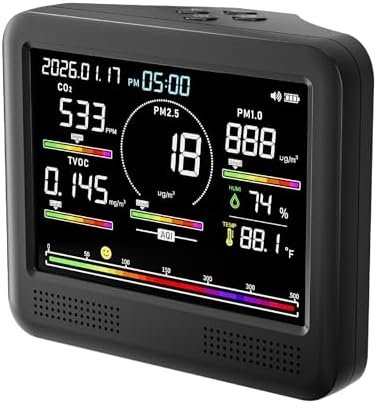
- Smart AQI Warning System with Audible Index: The 7-level AQI display provides an easy visual understanding of indoor air…
- Real-Time Indoor Air Quality Monitoring: Track CO2, PM0.3 PM0.5 PM1.0 PM5.0 PM10, HCHO, TVOC, temperature and humidity i…
- Portable Battery Operated Design: Built-in rechargeable battery with up to 9 hours of operation allows flexible air qual…
2) Because “bad air” usually feels like something else
Most people don’t immediately think “air quality problem.” They think:
- “Why is everyone tired?”
- “Why do headaches happen more at home?”
- “Why does the bedroom feel stuffy?”
- “Why does the allergy season feel like it moved indoors?”
Air quality monitors can’t diagnose anything (and they shouldn’t try). But they can show patterns that explain why a space feels uncomfortable.
For example:
- High CO₂ often shows up as sleepiness, brain fog, and “can’t focus” vibes.
- High humidity can lead to musty smells, condensation, and mold risk.
- PM2.5 spikes can show up after cooking, burning candles, or smoke drifting in.
The point isn’t panic—it’s clarity.
3) Because CO₂ monitoring is a game-changer for comfort and focus
CO₂ isn’t a “poison,” but it is a powerful signal.
If CO₂ rises, it usually means a room needs more fresh air. In many homes (especially apartments), CO₂ climbs quickly in:
- bedrooms at night
- home offices during work hours
- living rooms during movie nights (aka “the whole household breathing together”)
A monitor makes it obvious when it’s time to:
- open a window for 5–10 minutes
- increase ventilation
- run an air system (if available)
Without a monitor, it’s guesswork. With a monitor, it’s a simple routine.

- High Accuracy & Fast Refresh Data: With this smart sensor, the PM2.5 accuracy is ±15 µg/m³ while temperature and humidit…
- Multifunctional Air Quality Detector: The GoveeLife Air Quality Monitor conveniently measures 3 important indexes for in…
- Switchable Display: Press the top button for the clock & PM2.5 display. Long press for 2 seconds to switch to bright scr…
4) Because smoke and fine particles are sneaky (PM2.5 matters)
PM2.5 refers to tiny particles that can get deep into the lungs. Common sources include:
- cooking smoke
- candles/incense
- fireplaces
- wildfire smoke
- traffic pollution drifting indoors
A home might smell normal while PM2.5 is high—especially if the particles are coming from outside.
An air quality monitor helps catch:
- when the kitchen needs better ventilation
- when it’s smarter to keep windows closed (smoke days)
- when an air purifier would actually help
In other words: it prevents “why does the air feel heavy?” mysteries.
5) Because humidity is the quiet driver of mold, comfort, and sleep
Humidity is not just a “weather” issue.
In a home, humidity affects:
- mold and mildew risk
- dust mites
- dry skin and irritated throat
- how hot or cold a room feels
- sleep comfort
Most homes do best around 40–60% relative humidity (exact comfort varies by climate and season).
An air quality monitor makes humidity visible so it’s easy to decide:
- dehumidifier (if humidity is consistently high)
- humidifier (if it’s extremely dry in winter)
- better bathroom ventilation
Without numbers, humidity problems are usually handled with vibes. Vibes are not reliable.

- ALWAYS-ON AIR QUALITY SENSORS: WiFi connected indoor air quality monitor measuring radon gas, PM2.5 (air pollution detec…
- ACCURATE DIGITAL RADON DETECTOR: Radon is the number one cause of lung cancer among non-smokers and kills more than 6x t…
- SMART AIR QUALITY MONITORS YOU CAN TRUST: With 15 years of experience in indoor radon and air quality monitoring, Airthi…
6) Because it helps air purifiers work smarter (and saves money)
A lot of people buy an air purifier the way people buy a treadmill:
with hope, good intentions, and no plan.
An air quality monitor makes purification more effective because it shows:
- whether the purifier is actually lowering particles
- which rooms need help most
- when spikes happen (so the purifier can be placed strategically)
Instead of running an air purifier 24/7 “just in case,” you can make decisions based on data.


7) Because it’s a “small change” that improves home decisions fast
This is the underrated part.
An air quality monitor doesn’t require renovations. It doesn’t require a subscription to function (depending on the model). It just sits there and quietly answers questions.
Once the numbers are visible, tiny changes become obvious:
- crack a window during cooking
- run the bathroom fan longer
- move a purifier closer to the problem area
- stop burning that candle that turns the air into a campfire reenactment
Small changes, big comfort.
What to look for in an air quality monitor (simple checklist)
Not every monitor measures the same things. The most useful categories are:
- CO₂ (best for ventilation and focus)
- PM2.5 (best for smoke/dust/cooking particles)
- Humidity (best for mold risk and comfort)
- Temperature (nice for context)
Some monitors also track VOCs (chemical fumes). VOC readings can be helpful, but they’re often less precise on consumer devices—so it’s best to treat VOC as a “trend signal,” not a lab measurement.
Other good features:
- easy-to-read screen (or a very good app)
- reliable calibration (especially for CO₂)
- alerts (optional but helpful)
- multi-room support if more than one monitor is planned
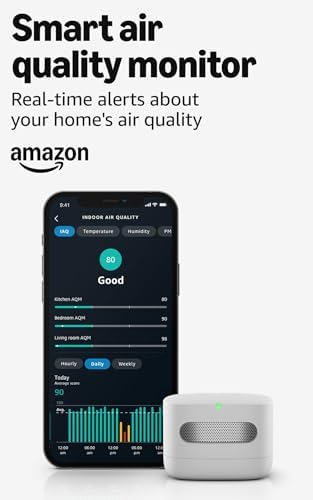
- Know your air – An Alexa air quality monitor that makes it easy to understand what’s in your indoor air.
- Track and measure – Our indoor air quality monitor keeps tabs on 5 key factors: particulate matter (PM 2.5), volatile or…
- Stay informed – Get an indication of current indoor air quality from the color-coded LED, and detailed information and a…
Where to place an air quality monitor (so it actually helps)
For most homes, the best starting places are:
- Bedroom (sleep + CO₂ + humidity)
- Home office (focus + CO₂)
- Living room (shared air)
- Kitchen nearby (PM2.5 spikes from cooking)
Avoid placing it:
- directly next to windows (it’ll fluctuate too much)
- right above a stove (it’ll be dramatic)
- right next to an air purifier output (it can skew readings)
Final thoughts
Air quality is one of the few “health” upgrades that affects everyone in the home—every day—without requiring constant effort.
An air quality monitor doesn’t magically fix the air. But it does something almost as valuable: it shows what’s happening, when it changes, and what actions actually help.
And once air problems are visible, they’re surprisingly easy to improve.
Because the best home upgrades aren’t always the flashiest.
Sometimes they’re the ones that make the air feel like you can finally breathe properly again.